







In aerospace manufacturing, cleanliness is not optional. It is critical to performance, safety and compliance.
Even microscopic contamination can compromise component reliability, coating adhesion or system performance. That is why aerospace manufacturers require cleaning processes that are precise, repeatable and validated.
Ultrasonic cleaning systems provide a highly controlled solution, enabling manufacturers to remove contaminants from complex components without damaging delicate surfaces.
Why Precision Cleaning Matters in Aerospace
Aerospace components operate in extreme environments where failure is not an option.
Contamination such as oils, machining residues, polishing compounds or fine particulates can lead to:
- Reduced coating adhesion.
- Corrosion risk.
- Mechanical failure.
- Reduced fatigue performance.
Precision cleaning ensures components meet strict aerospace standards before assembly or coating.
What Is Ultrasonic Cleaning?
Ultrasonic cleaning uses high-frequency sound waves transmitted through a liquid cleaning solution.
These waves create microscopic cavitation bubbles that collapse on the surface of the component, generating controlled energy that removes contaminants.
This process allows for:
- Deep cleaning of complex geometries.
- Removal of fine particles and residues.
- Consistent, repeatable results.
- Non-abrasive cleaning of sensitive components.
It is particularly effective where traditional cleaning methods cannot reach.
How Ultrasonic Cleaning Meets Aerospace Standards
Aerospace manufacturing requires strict adherence to cleaning and validation standards.
Ultrasonic cleaning systems support compliance by providing:
- Controlled and repeatable cleaning cycles.
- Consistent cleaning performance across batches.
- Measurable and documentable processes.
- Reduced operator variability.
This ensures components meet required cleanliness levels for critical applications.
Cleaning Complex Aerospace Components
One of the biggest advantages of ultrasonic cleaning is its ability to clean complex and intricate parts.
Typical applications include:
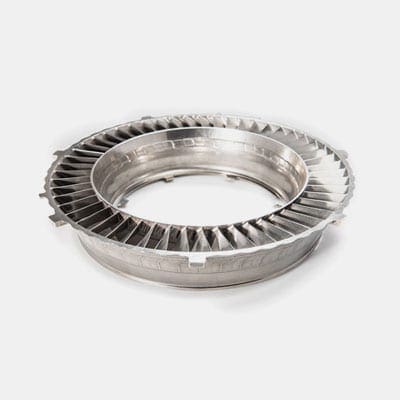
- Turbine components.
- Precision-machined aerospace parts.
- Hydraulic system components.
- Aerospace fasteners.
- Engine components.
Ultrasonic systems can reach internal features, small holes and detailed geometries that manual or spray cleaning cannot.
Benefits of Ultrasonic Cleaning for Aerospace
1. Consistent and Repeatable Results
Ultrasonic systems deliver uniform cleaning across all components, reducing variability and improving quality control.
2. Non-Abrasive Cleaning Process
Unlike mechanical cleaning methods, ultrasonic cleaning does not damage surfaces or alter tolerances.
3. Improved Process Efficiency
Automated cleaning cycles reduce manual labour and improve throughput.
4. Enhanced Surface Preparation
Ultrasonic cleaning ensures surfaces are free from contaminants before coating, bonding or assembly.
Precision Cleaning Systems for Aerospace Manufacturing
Modern ultrasonic cleaning systems are designed to integrate into aerospace production environments.
These systems can include:
- Multi-stage cleaning processes.
- Rinse and drying stages.
- Filtration and fluid management.
- Temperature and process control.
This allows manufacturers to achieve consistent results while maintaining efficiency and compliance.
Ultrasonic Cleaning vs Traditional Cleaning Methods
Compared to manual or spray cleaning:
- Ultrasonic systems provide deeper cleaning.
- Reduce reliance on operator skill.
- Improve repeatability.
- Minimise risk of contamination.
This makes them the preferred choice for high-spec aerospace applications.
Supporting Aerospace Finishing Processes
Ultrasonic cleaning is often used alongside finishing processes such as:
- Shot blasting.
- Vibratory finishing.
- Centrifugal finishing.
- Polishing.
By removing residues after finishing, ultrasonic cleaning ensures components are ready for the next stage of production.
Why Aerospace Manufacturers Choose Ultrasonic Cleaning
Manufacturers adopt ultrasonic cleaning systems to:
- Meet strict cleanliness standards.
- Improve consistency across production.
- Reduce contamination risk.
- Enhance coating and bonding performance.
- Support validated manufacturing processes.
This makes ultrasonic cleaning a critical part of modern aerospace manufacturing.
FAQs
1. What is ultrasonic cleaning used for in aerospace?
It is used to remove contaminants such as oils, residues and particulates from aerospace components before assembly or coating.
2. Can ultrasonic cleaning handle complex aerospace parts?
Yes. It is highly effective for cleaning intricate geometries, internal features and precision components.
3. Is ultrasonic cleaning safe for sensitive components?
Yes. It is a non-abrasive process that cleans without damaging surfaces or affecting tolerances.
4. Does ultrasonic cleaning meet aerospace standards?
Yes. It provides controlled, repeatable processes that support validation and compliance requirements.
5. Can ultrasonic cleaning be automated?
Yes. Modern systems are fully automated and can be integrated into production lines for consistent results.
Explore Ultrasonic Cleaning Solutions for Aerospace
If you are working with aerospace components that require precision cleaning, ultrasonic systems provide a reliable and efficient solution.
Explore ActOn’s ultrasonic cleaning solutions designed for aerospace applications
Call: +44 (0) 24 7646 6914
Email: sales@acton-finishing.co.uk