






Surface finishing plays a critical role in the performance, safety and reliability of medical components. From surgical instruments to orthopaedic implants, every part must meet strict requirements for cleanliness, surface integrity and dimensional accuracy.
To achieve this, manufacturers require highly controlled and repeatable finishing processes that deliver consistent results without compromising part geometry.
At ActOn Finishing, advanced surface finishing technologies are used to support medical manufacturers in achieving high-quality, compliant and production-ready components.
Why Surface Finishing Is Critical in Medical Manufacturing
Medical components operate in environments where performance cannot be compromised.
Surface condition directly affects:
- Cleanability and sterilisation effectiveness.
- Biocompatibility.
- Wear resistance and longevity.
- Corrosion resistance.
- Patient safety.
Even minor surface imperfections can impact performance or introduce risk. This makes precision surface finishing an essential step in the manufacturing process.
The Challenge with Traditional Finishing Methods
Standard finishing methods are not always suitable for medical applications.
Manufacturers often face challenges such as:
- Inconsistent surface finishes across batches.
- Risk of damaging complex geometries.
- Limited capability on intricate or delicate components.
- Longer processing times.
- Difficulty achieving required surface roughness levels.
To overcome these challenges, more advanced and controlled finishing technologies are required.
Advanced Surface Finishing Technologies for Medical Components
1. Centrifugal High Energy Finishing
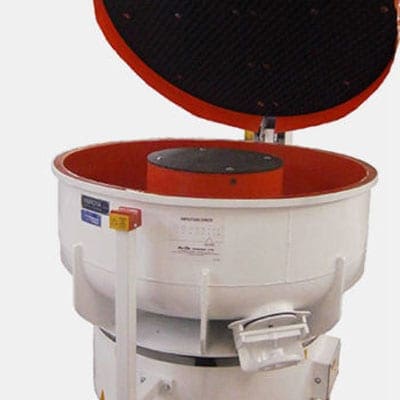
Centrifugal High Energy (CHE) finishing is one of the most effective methods for achieving rapid and consistent surface refinement.
This process delivers:
- 30 x faster processing times compared to conventional methods.
- Highly uniform surface finishes achieving Ra’s under 0.09 micrometers and perfect mirror finishes.
- Effective deburring and polishing of precision components.
- Improved efficiency for batch production.
- Removal of heavy manufacturing defects.
CHE systems are widely used for orthopaedic implants, surgical components and precision-engineered medical parts where both speed and consistency are essential.
2. Drag Finishing for High-Value Components
Drag finishing provides a highly controlled finishing process, making it ideal for delicate or high-value medical components.
Key advantages include:
- Precise control over finishing parameters.
- Excellent surface quality on complex geometries.
- Zero risk of part-on-part damage.
- Consistent results for critical components.
This process is particularly suited for implants, surgical tools and components with intricate shapes or tight tolerances.
3. Dry Electropolishing for Complex Geometries
Dry electropolishing technology offers a clean and controlled solution for finishing complex and sensitive medical components.
This process enables:
- Finishing of complex internal and external geometries.
- Improved surface smoothness and cleanliness.
- Reduced need for aggressive mechanical processes.
- Enhanced consistency across components.
Dry electropolishing is especially effective for parts where traditional finishing methods may struggle to reach or maintain precision.
Applications in Medical Manufacturing
Advanced surface finishing processes are used across a wide range of medical components, including:
- Orthopaedic implants.
- Surgical instruments.
- Dental components.
- Medical fasteners.
- Precision-engineered device components.
- Stainless steel medical parts.
Each application requires a tailored approach to achieve the correct surface finish without affecting performance or compliance.
Using any of the above technologies you can achieve finishing applications such as:
- Deburring and removal of heavy manufacturing defects.
- Smoothing and radiusing for precision fit.
- Brightening and mirror-polishing for visual and functional enhancement.
- Degreasing and cleaning before assembly.
- Super-finishing and achieving significant reduction in surface roughness.
Why Process Selection Matters
Selecting the right surface finishing process is essential for achieving the required balance between quality, efficiency and cost.
Different components require different approaches depending on:
- Material type.
- Geometry and complexity.
- Required surface roughness.
- Production volume.
- Regulatory requirements.
Working with an experienced finishing partner ensures that the most effective process is selected for your specific application.
A Complete Surface Finishing Solution for Medical Manufacturers
ActOn Finishing provides more than just machinery. We work with manufacturers to develop complete finishing solutions that deliver consistent, repeatable and high-quality results.
Our support includes:
- Process development and optimisation.
- Free finishing trials.
- Tailored finishing systems manufacturing, delivering and installation.
- Operator training.
- Consumables recommendation, manufacturing and supplying.
- Ongoing technical support.
FAQs
1. What is the best surface finishing method for medical components?
The best method depends on the component, but centrifugal, drag finishing and dry electropolishing are commonly used for high-precision medical applications.
2. Why is surface finish important in medical devices?
Surface finish affects cleanliness, biocompatibility, durability and overall performance of medical components.
3. Can complex medical components be finished effectively?
Yes. Advanced processes such as drag finishing and dry electropolishing are designed to handle complex geometries with high precision.
4. How can I test a finishing process before committing?
ActOn Finishing offers free trials, allowing you to evaluate results on your own components before selecting a process.
5. What industries use these finishing technologies?
These technologies are widely used in medical, aerospace and precision engineering industries.
Learn More About Surface Finishing for Medical Components
If you are looking to improve surface quality, reduce processing time or optimise your finishing process, our team can help.
Explore our advanced surface finishing technologies or request a free trial to see the results on your own components.
Call: +44 (0) 24 7646 6914
Email: sales@acton-finishing.co.uk