






Metal AM Post-Processing
Metal additive manufacturing creates complex geometries and high-performance components that are difficult or impossible to produce using traditional manufacturing methods.
However, most metal AM parts cannot move directly from the printer into production use.
They require controlled post-processing and surface finishing to:
- Remove residual powder.
- Reduce surface roughness.
- Improve cosmetic finish.
- Prepare critical surfaces.
- Achieve dimensional consistency.
- Meet functional specifications.
At ActOn Finishing, metal AM post-processing is approached as a staged process rather than a single finishing operation.
The correct sequence typically includes:
- Depowdering.
- Surface refinement.
- Smooth finishing or polishing.
- Final surface optimisation.
Different finishing technologies are then selected depending on:
- Material type.
- Surface finish requirements.
- Geometry complexity.
- Throughput needs.
- Functional performance targets.
This blog focuses specifically on metal additive manufacturing finishing, separate from polymer AM processes.
Why Metal AM Parts Require Post-Processing
Metal additive manufacturing methods such as:
- SLM (Selective Laser Melting).
- DMLS.
- Binder jetting.
Often leave parts with:
- Residual powder.
- Rough surface texture.
- Support structures.
- Inconsistent surface finish.
- Difficult-to-access internal geometries.
Without post-processing, these issues can affect:
- Mechanical performance.
- Coating adhesion.
- Fatigue resistance.
- Surface appearance.
- Assembly tolerances.
Post-processing is therefore essential for transforming printed components into production-ready parts.
Depowdering Metal AM Parts in DI Shot Blasting Cabinets
The first stage in the metal AM finishing process is typically depowdering.
At ActOn, depowdering for metal additive manufacturing parts is carried out using:
1. DI shot blasting cabinets
These systems are designed to remove:
- Residual powder.
- Loose contamination.
- Unfused particles.
from complex metal AM geometries.
Depowdering is particularly important for:
- Internal channels.
- Lattice structures.
- Complex geometries.
- Precision engineering parts.
Proper depowdering improves both surface preparation and downstream finishing consistency.
Surface Finishing After Depowdering
Once depowdering is complete, additional finishing processes are selected depending on the required result.
Different surface finishing systems achieve very different outcomes:
- Surface smoothing.
- Surface refinement.
- Polishing.
- Bright finishing.
- Reduced roughness values.
- Improved cosmetic appearance.
ActOn uses several finishing technologies depending on the application.
CHE Finishing for Metal AM Components
CHE (Centrifugal High Energy) finishing is commonly used where:
- Faster finishing is required.
- Greater control of the process.
- Ra under 0.1 micrometers is required.
- A smooth polished finish is needed.
CHE systems are particularly effective for:
- Reducing roughness on SLM parts.
- Smoothing difficult geometries.
- Improving surface consistency.
- Processing harder but also more fragile components.
The high-energy process generates faster media movement and increased surface interaction compared with standard vibratory systems.
Centrifugal Disc Finishing for Precision Surface Refinement
Centrifugal disc finishing is often selected for:
- Precision engineering parts.
- Smaller metal AM components.
- Controlled surface smoothing.
- Repeatable batch finishing.
The process provides:
- High media energy.
- Controlled finishing action.
- Consistent surface contact.
This allows manufacturers to achieve:
- Lower roughness values.
- Improved cosmetic finishes.
- Better surface consistency.
while maintaining process repeatability.
Dry Electropolishing for Precision Polishing
Dry Electropolishing technology is used for:
- Fine surface finishing.
- Precision polishing.
- Surface smoothing on conductive materials.
DLyte is particularly suitable where:
- Very fine finishes are required.
- Complex geometries are difficult to polish mechanically.
- Consistency is critical.
The process helps improve:
- Surface quality.
- Cleanability.
- Cosmetic finish.
- Functional performance.
DLyte is often used after blasting or initial surface refinement stages.
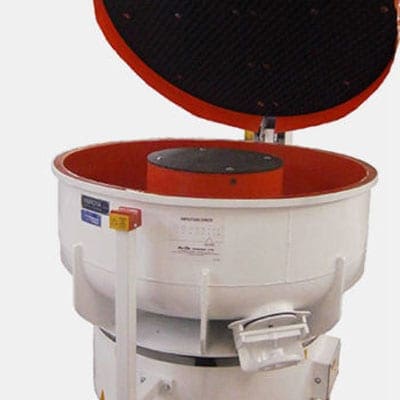
Vibratory Finishing for Metal AM Parts
Vibratory finishing remains an effective process for:
- General smoothing.
- Edge refinement.
- Surface consistency.
- Batch processing.
The process can be adapted using:
- Ceramic media.
- Plastic media.
- Stainless steel media.
Depending on:
- Material hardness.
- Finish requirements.
- Part geometry.
Vibratory systems are often selected where:
- Larger batch volumes are needed.
- Surface refinement rather than aggressive material removal is required.
Matching the Process to Material and Finish Requirements
No single finishing process suits every metal AM component.
Correct process selection depends on:
- Printed material.
- Geometry complexity.
- Surface roughness targets.
- Cosmetic requirements.
- Production volume.
- Mechanical performance requirements.
For example:
- Titanium aerospace parts may require different processing from stainless steel tooling.
- Fine polishing requirements may favour dry electroplating or CHE finishing.
- Larger batch smoothing may favour vibratory systems.
- Faster surface refinement may require CHE finishing.
ActOn helps manufacturers select the correct finishing route based on the application.
Surface Roughness Reduction and Support Removal
Metal AM finishing often focuses on reducing surface roughness while improving part functionality.
Post-processing can help:
- Reduce Ra values.
- Remove support marks.
- Improve fatigue performance.
- Enhance coating adhesion.
- Improve fluid flow characteristics.
| High Rate of Surface Finish Reduction | Maintenance of Geometry | Intricate Finishing of Complex Geometry | High Gloss, “Mirror” Finish | |
|---|---|---|---|---|
| Vibratory Finishing Machines | 2 | 4 | 2 | 2 |
| CDF Machine | 4 | 3 | 2 | 3 |
| CHEF Series | 5 | 3 | 2 | 4 |
| DLyte Technology | 1 | 5 | 5 | 5 |
| AM Blasting | 1 | 5 | 4 | 1 |
Why Manufacturers Choose ActOn Finishing
ActOn provides:
- Metal AM post-processing expertise.
- DI shot blasting systems.
- CHE finishing systems.
- Centrifugal disc finishing equipment.
- DLyte technology.
- Vibratory finishing solutions.
- Process trials and technical support.
Our engineers help manufacturers improve:
- Surface quality.
- Production consistency.
- Process efficiency.
- Surface roughness reduction.
- Finishing repeatability.
FAQs
How are metal AM parts depowdered?
Metal AM parts are typically depowdered using DI shot blasting cabinets designed to remove residual powder from complex geometries and internal features.
Which ActOn systems finish metal 3D printed parts?
ActOn supplies CHE finishing systems, centrifugal disc finishers, DLyte systems, vibratory finishing equipment, and DI shot blasting cabinets for metal AM post-processing.
When should CHE be used for metal AM?
CHE finishing is often selected when faster surface refinement and higher energy finishing are required on metal AM components.
Can DLyte be used after blasting?
Yes. DLyte is commonly used after depowdering or initial surface refinement stages to achieve finer polishing and smoother surface finishes.
How do I choose the right finishing process?
The correct process depends on material type, geometry complexity, surface finish targets, throughput requirements, and the final application of the part.
Request a Metal AM Finishing Trial
Need help developing the right post-processing route for metal additive manufacturing parts?
Call: +44 (0) 24 7646 6914
Email: sales@acton-finishing.co.uk