





Additive manufacturing (AM) is revolutionising how components are designed and produced, particularly in high-performance sectors such as aerospace, medical, and automotive. However, most metal 3D-printed components require surface improvement to meet the functional and aesthetic standards demanded by end-users.
At ActOn Finishing, we understand that post-processing is a crucial stage in the additive manufacturing workflow. Our complete range of surface finishing solutions has been developed to deliver the speed, consistency, and precision that modern manufacturers require.
Why Post-Processing Is Essential for Metal 3D-Printed Parts
While metal additive manufacturing enables the creation of highly complex geometries, the nature of the layer-by-layer process often leaves parts with rough or uneven surfaces, residual powder, and support structures. These must be removed or refined to achieve the required surface quality, dimensional accuracy, and performance.
Traditionally, post-processing has relied on manual methods such as hand polishing and grinding. These are labour intensive, prone to inconsistencies, and often lead to high rejection rates and rework.
To address these challenges, ActOn Finishing has developed a portfolio of surface finishing technologies that ensure repeatable, high-quality results, while reducing time and cost.
Step 1: Efficient Powder Removal with AM Blasting Technology
For powder-based metal additive manufacturing processes, the first step after printing involves removing any residual powder left on the part.
The AM Blasting technology has been specially designed to efficiently clean even the most complex geometries, ensuring the part is ready for subsequent finishing stages. For large or intricate components, the AM DI Depowdering Blasting System provides a manual but controlled solution, suitable for blasting individual or oversized parts. This system ensures thorough powder removal while maintaining part integrity and operator safety.
Step 2: Superior Surface Finishing & Mirror Finishing
With Centrifugal High Energy (CHEF) Machines
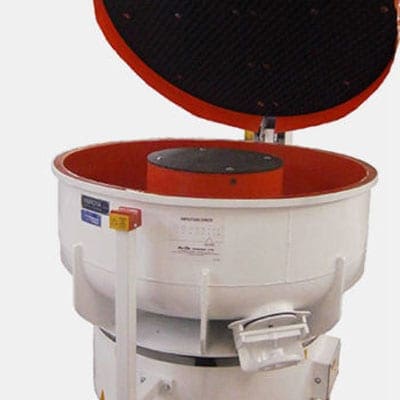
The next critical step is to achieve the desired surface smoothness and polish. Our Centrifugal High Energy Finishing (CHEF) machines are ideal for this stage, delivering surface finishes that are difficult or impossible to achieve through standard vibratory methods.
The CHEF process is:
-
Up to 10 times faster than traditional finishing,
-
Capable of achieving mirror-like finishes, and
-
Exceptionally efficient for batch finishing metal components.
The technology is particularly effective for parts requiring high rates of defect removal or ultra-smooth surfaces. With a controlled process environment, manufacturers achieve consistent, repeatable results that meet the tightest industry standards.
With Dry Electropolishing Technology
For parts that demand a high-gloss, mirror finish, ActOn recommends dry electropolishing technology. This innovative process offers several unique advantages:
-
Produces a high-quality, reflective finish on machined, sintered, cast, and 3D-printed metal parts.
-
Reaches every corner of the part, including internal cavities that cannot be accessed mechanically.
-
Selectively removes material only from the peaks of surface roughness, preserving sharp edges and component geometry.
Dry electropolishing is particularly suited for applications in medical implants, jewelry, and aerospace components, where both appearance and performance are critical.

Case Studies: Proven Performance in Metal AM Finishing
Cost-Effective Surface Finishing for SLM 3D Parts
-
Machine Used: CPM10 Centrifugal High Energy Machine
-
Results Achieved:
-
Ra reduced to below 1 μm in just 5 hours (80% faster than traditional methods).
-
Ra of 2–3 μm achieved within 30 minutes.
-
Support structures removed during the process.
-
46% cost savings on the overall finishing process.
-
This project also examined surface finish parameters, component and media wear, and the effects of varying abrasive grades—demonstrating the CHEF system’s efficiency and versatility.
Other Successful Applications
-
3D Printed Ornament: Ra before 16 μm, after 0.18 μm
-
Femoral Implant: Ra before 21.01 μm, after 3.03 μm
-
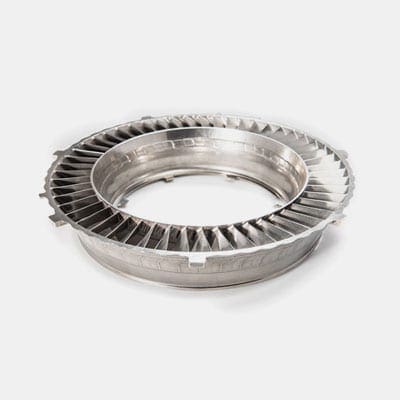
Aerospace Component:
-
Ra reduced from 2.6175 μm to 1.3072 μm
-
Rz reduced from 12.9495 μm to 4.9578 μm
-
These results confirm the effectiveness of ActOn’s finishing technologies across multiple industries and materials.

Which Technology Works Best for Your Part?
At ActOn Finishing, we understand that no single process fits all applications. That’s why we’ve developed a scoring matrix to help identify the most suitable technology for your specific needs:
| Technology | High Rate of Surface Finish Reduction | Maintenance of Geometry | Intricate Finishing of Complex Geometry | High Gloss, “Mirror” Finish |
|---|---|---|---|---|
| Vibratory Finishing Machines | 2 | 4 | 2 | 2 |
| Disc Finishing Machines | 4 | 3 | 2 | 3 |
| CHEF Series | 5 | 3 | 2 | 4 |
| DLyte Technology | 1 | 5 | 5 | 5 |
| AM Blasting Technology | 1 | 5 | 4 | 1 |
Notes: Scale 1 to 5, where 5 indicates the most suitable technology for achieving the desired finish.
In many cases, a combination of processes—such as blasting followed by CHEF finishing and dry electropolishing—yields optimal results.
Complete Surface Finishing Solutions from ActOn
From depowdering to mirror finishing, ActOn Finishing offers a comprehensive range of post-processing technologies for metal additive manufacturing.
Our solutions are designed to:
-
Reduce process time and costs,
-
Improve repeatability and quality, and
-
Ensure that every component meets end-user expectations.
Whether you’re producing medical implants, aerospace parts, or precision-engineered components, ActOn’s expertise ensures your 3D-printed parts are finished faster, smarter, and better.
Contact ActOn Finishing to discover how our innovative surface finishing technologies can transform your additive manufacturing workflow.