





In precision manufacturing, even the smallest surface flaw can compromise performance. That’s why advanced finishing processes like drag finishing have become essential.
At ActOn Finishing, we supply the ADF Series Drag Finishing Machines, designed to deliver uniform, repeatable, and damage-free results across complex, high-value components. But what exactly is drag finishing and when should you use it?
What Is Drag Finishing?
Drag finishing is a high-energy surface finishing process where parts are clamped onto rotating spindles and dragged through a specially designed media. This motion generates controlled friction that achieves precise deburring, edge rounding, smoothing, and polishing in a fraction of the time required by traditional finishing.
Unlike vibratory or tumbling processes, parts remain fixed in place. This prevents part-on-part contact, protecting delicate components and delivering a uniform finish every time.
Key Benefits of Drag Finishing
- High precision finishes with minimal manual intervention.
- Reduced processing times compared to conventional methods.
- Zero part-on-part contact, ensuring component integrity.
- Repeatable results, ideal for regulated industries.
- Effective on intricate geometries, preventing edge damage.
- Automated operation for reduced labour and higher efficiency.
When Should You Use Drag Finishing?
Drag finishing is best suited when you need:
1. Tight Tolerances
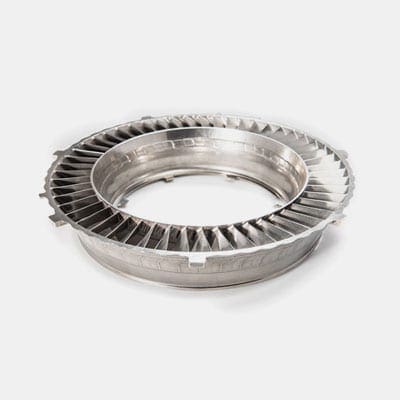
For aerospace turbine blades, transmission gears, or surgical instruments, where accuracy is critical.
2. Delicate Component Handling
Preventing scratches or deformation on medical implants, jewellery, or 3D-printed parts.
3. Faster Throughput
When traditional methods are too slow for production demands.
4. Mirror-Quality Surfaces
For luxury goods, defence applications, and additive manufacturing components.
Industries benefiting from drag finishing include:
- Aerospace (blades, engine parts).
- Automotive (gears, transmission parts).
- Medical (implants, surgical instruments).
- Tooling (cutting tools, dies, moulds).
- Additive Manufacturing (3D-printed metals and polymers).
- Luxury & Defence (jewellery, firearms, military-grade tools).
Why Choose ActOn’s ADF Drag Finishing Machines?
ActOn’s ADF series is engineered to combine state-of-the-art technology with cost-effectiveness, offering:
- Models with 3 to 36 part holders, scalable to your needs.
- PLC and HMI control panels for precision and ease of use
- Optional angled part holders for complex geometries.
- Custom sizes available for specialist applications.
FAQs
What makes drag finishing different from vibratory finishing?
In vibratory finishing, parts tumble freely, whereas drag finishing keeps them fixed on spindles. This prevents part-on-part contact and ensures uniform results.
What materials can be processed with drag finishing?
It works effectively on metals, alloys, polymers, and delicate parts, making it versatile across industries.
How long does drag finishing take?
Processing times vary by application but are significantly faster than manual finishing, often cutting cycles by more than half.
Is drag finishing suitable for additive manufacturing?
Yes. Drag finishing delivers precise smoothing and polishing of complex parts without damaging intricate features.
Request a free trial
Call: +44 (0) 24 7646 6914
Email: sales@acton-finishing.co.uk